All KINGs MEN
is ‘resonating’ with the general notion of extreme politics with a perspective from the past.
This score choreography is influenced by German sociologist and political scientist Hartmut Rosa. His conviction is that political extremism and political division is a ‘resonance catastrophe.’ He thinks that the focus of Modern society on speed, efficiency and control leads to alienation, a distorted relationship with the world and a sense of meaninglessness. His solution isn’t to gain more control, resources and achieve more happiness, but a shift in our relationship to the world.
‘Resonating’ with extreme politics is not agreeing, especially not with regime’s who commit crimes against humanity. It means to maintain a certain vulnerability and openness to communicate across differences. Maybe resonating with something we do not agree with will make it possible to find common ground or balanced solutions. What it certainly will create is personal and possibly communal agency.
‘All KING’s MEN’ is part of RESONANCE, an evening of all sorts of DANCE by the MARIPOSA Collective / Boulder CO.
score choreography / Tanja London
performance / Kimberly Han
TV & VIDEO installation / based on Justin Watson’s ‘Two entities sharing ideology’ [2016]
costume, video & soundscore design / Tanja London
music / Roberto Zuniga
THANKS / Justin Watson, Nita Little, MARIPOSA collective, Spandex Warehouse, Til Luchau
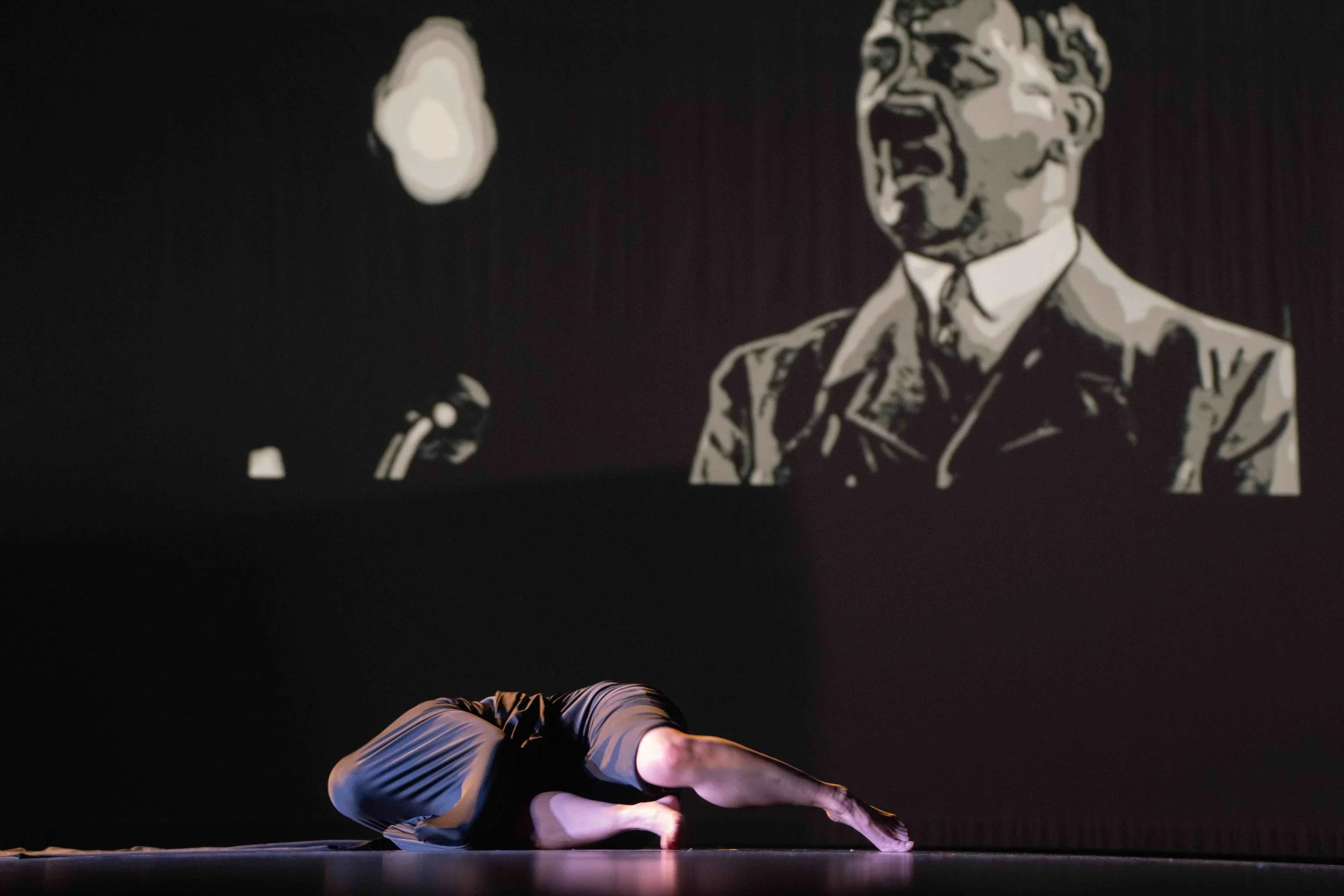
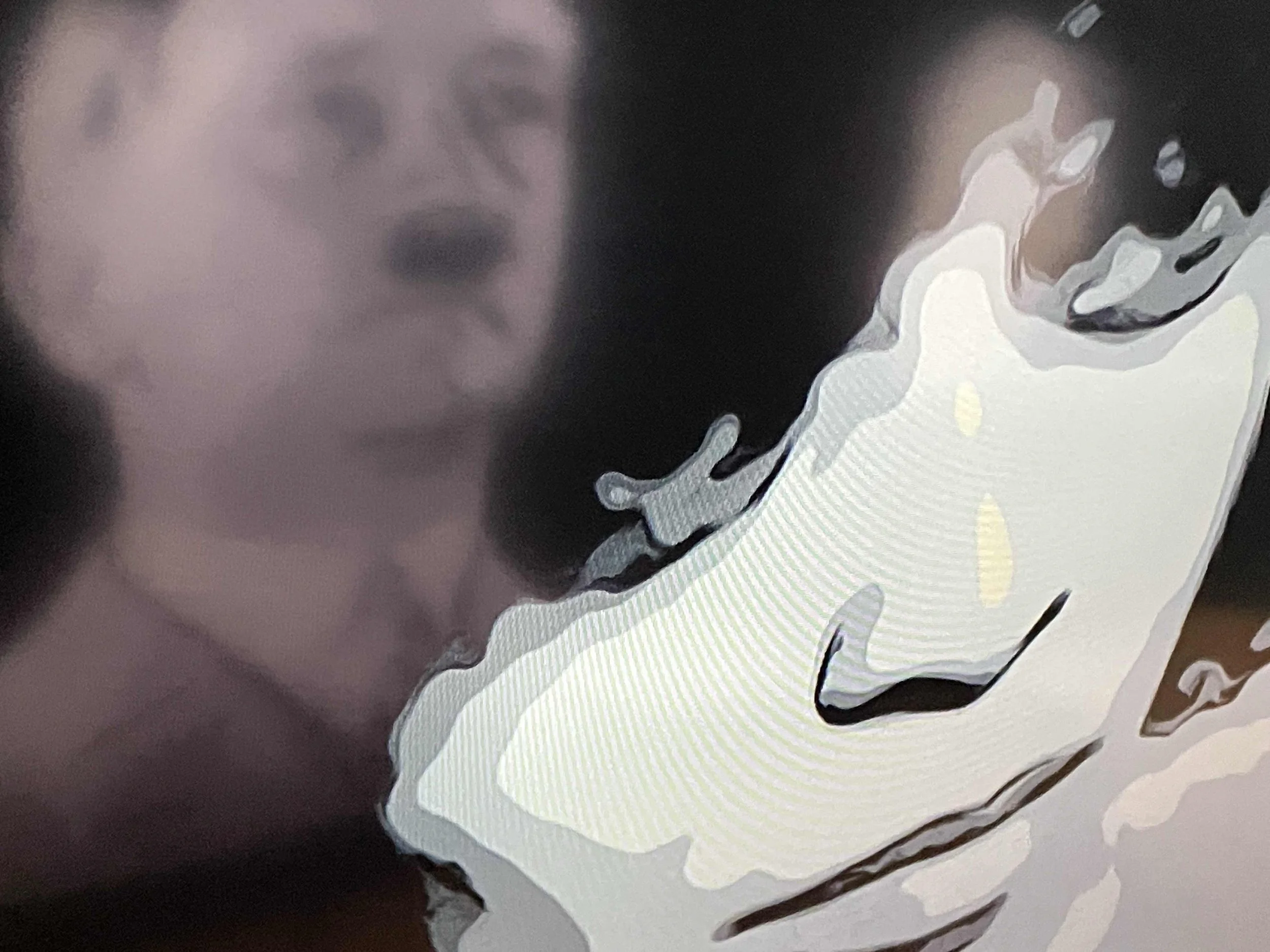
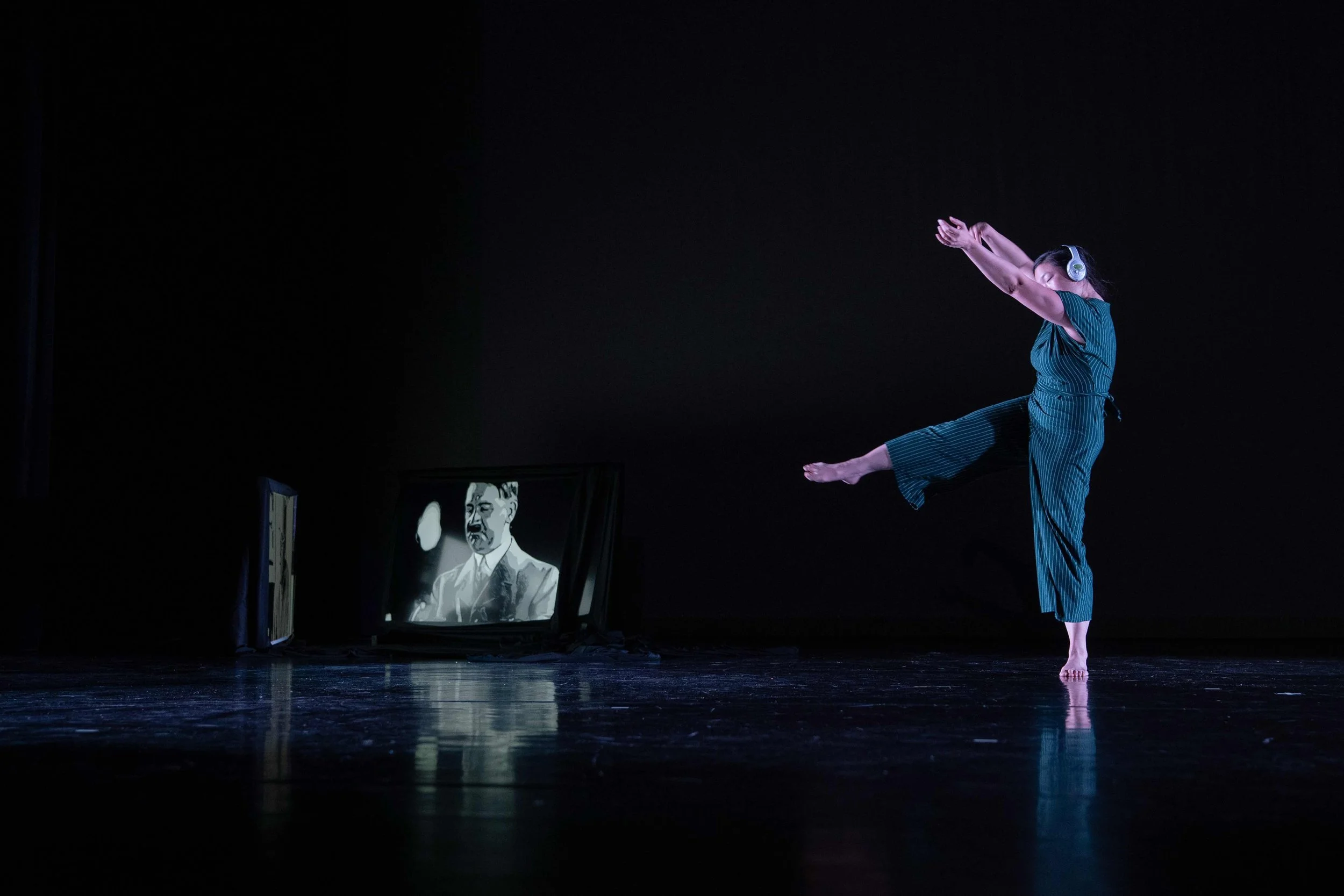
photos by Virginia Harold and Tanja London
What is a SCORE CHOREOGRAPHY?
A score choreography has no real steps. It has a rigorous set of frameworks, intentions and relationships as well as detailed movement descriptions. These parameters function as choreographic instructions, which allows freedom for the performer to interpret the instructions in an improvisational, immediate way in the moment of the performance.
SOUNDSCORE ELEMENTS
Voice cloud [Winston Churchill, Benito Mussolini, Josef Stalin, Slavoj Zizek’s lecture on ideology, crowds, Adolf Hitler]
Adolf Hitler’s speech for the 6th Nazi party convention
music: ‘Diarios Clasicos’ by Roberto Zuniga
Voice over: ‘sound cancellation on’ by Kimberly Han
Naom Chomsky’s lecture about the U.S. being a polyarchy not a democracy
TRANSCRIPTS & TRANSLATIONS
Slavoj Zizek’ lecture on ideology
“According to our common sense we think that ideology is something blurring, confusing our straight view. Ideology should be glasses, which distort our view. And critique of ideology should be the opposite, like we take off the glasses so that we can finally see the way things really are. This precisely, and here the pessimism of the view, which is well justified … This precisely is the ultimate illusion. Ideology is not something imposed on ourselves. Ideology is our spontaneous relationship to our social world, how we perceive each meaning and so on, and so on. We, in a way, enjoy our ideology.”
Adolf Hitler’s speech for the 6th Nazi party convention
“The 6th party convention of [the NAZI] movement is coming to an end. What might look like the most impressive development of political power to millions of Germans who are not part of our party, is for the hundred of thousands of political fighters so much more: The large personal and intellectual meeting of the old guard and fighting comrades.
And maybe some of us remember nostalgically the times when it was hard to be a National Socialist despite our party’s undeniable greatness in the present. [large applause] When [the NSDAP] only had 7 party members it already had 2 basic principles:
- First: the party wants to be a true world view party.
- Second: the party wants to be - without compromises - the strongest power and the only political power in Germany! [large applause]”
Naom Chomsky’s lecture on polyarchy
“The United States is not a democracy. It’s what’s called in the technical literature a polyarchy. That’s the term vetted by the leading democratic theorist Yale Professor Robert Dahl, but the idea is old, it goes way back to James Madison and the foundation of the constitution. A polyarchy is a system in which power resides in the hands of those who Madison called the wealth of the nation, the responsible class of men and the rest of the population is fragmented, distracted - allowed to participate. Every couple years they are allowed and come and say:” Yes, thank you, why don’t you continue for another four years.””
DEFINITIONS
POLYARCHY [excerpts from Britannica]
“polyarchy, which means “rule by many,” describes the process of democratization, in contrast to democracy itself.
The concept of polyarchy is Dahl’s attempt to develop an empirical definition of democratization as well as to elaborate a set of normative criteria for deciding whether or not a political system can be counted as a democracy.
The necessary institutions are, according to Dahl:
Universal suffrage and the right to run for public office
Free and fairly conducted elections for all adults
Availability and observance of the right to free speech and protection to exercise it
The existence of and free access to alternative information (not controlled by government)
The undisputed right to form and to join relatively autonomous organizations—in particular, political parties (and, crucially, parties in opposition)
Responsiveness of government (and parties) to voters
Accountability of government (and parties) to election outcomes and government.
(…)Hence, in Dahl’s view, the extent to which those societal actors can and do operate autonomously, as well as independently from the state, will enhance the democratic quality of a polity. (…)
Central to the adequate functioning of polyarchy is not only the existence and operation of institutions but also the existence of societal groups and adequate space for them to maneuver and organize. (…).”
AMYGDALA [excerpts from Britannica]
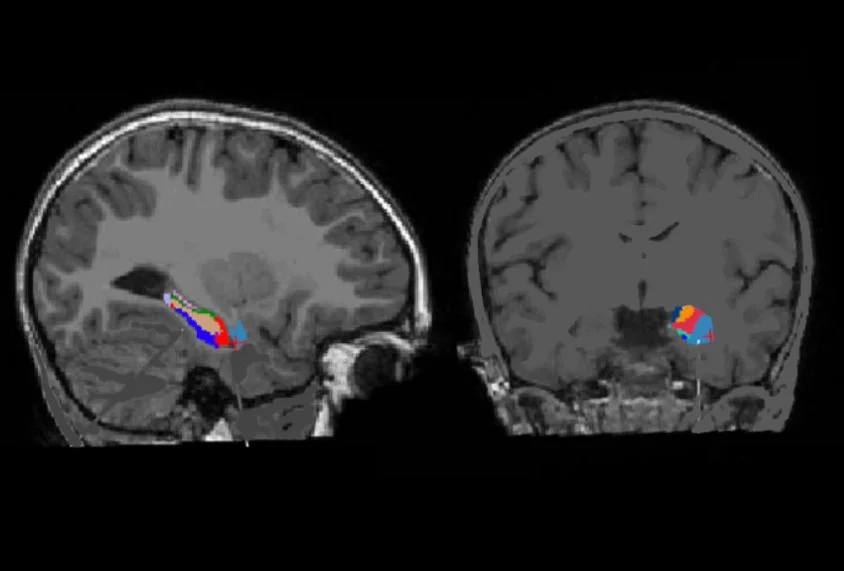
“(Is a) region of the brain primarily associated with emotional processes. The name amygdala is derived from the Greek word amygdale, meaning “almond,” owing to the structure’s almondlike shape. The amygdala is located in the medial temporal lobe, just anterior to (in front of) the hippocampus. Similar to the hippocampus, the amygdala is a paired structure, with one located in each hemisphere of the brain. The amygdala is part of the limbic system, a neural network that mediates many aspects of emotion and memory. Although historically the amygdala was considered to be involved primarily in fear and other emotions related to aversive (unpleasant) stimuli, it is now known to be involved in positive emotions elicited by appetitive (rewarding) stimuli.”